
Rules
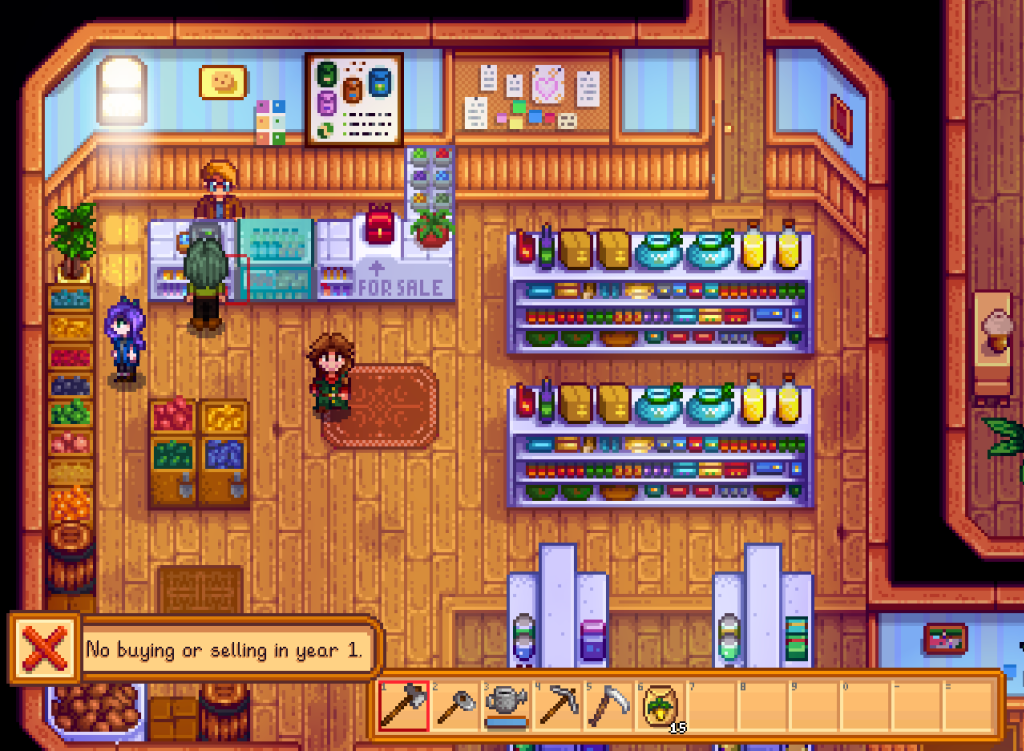
- Buy and sell nothing the first year.
- This includes tool upgrades, event items, and weapons.
- Do not use the starting 500 gold or 15 parsnip seeds.
Challenge Considerations
Multiplayer: Selling small items such as a forgeable is acceptable if you need to pause the game during longer play sessions.
Holiday/Event items: Selling these can be seen as taking the cash alternative to any prize won.
Beach bridge: 300 wood to repair the bridge can be argued as bartering for a service.
Romance: If you consider giving a gift buying someone’s affection (leveling up hearts), then wait until year 2. Otherwise, the first year is a great time to max out hearts.
Community Center: Donations aren’t viewed as buying or selling anything. It’s also a good challenge for year 1 to see if you can accumulate enough money through quests to do the vault.
Recommendations
Multiplayer: Having one person focused on resource gathering (fishing, foraging and mining) and another doing quests to generate income really helps start year 2 off right.
Farm: Meadowlands’ two chickens provide food if you want to level up combat and hit the mines hard early on. Expect to run out of eggs as you can’t buy hay in year 1, so the chickens will stop producing eggs sometime in the fall/winter.
Challenge Discussion
Player Motivation
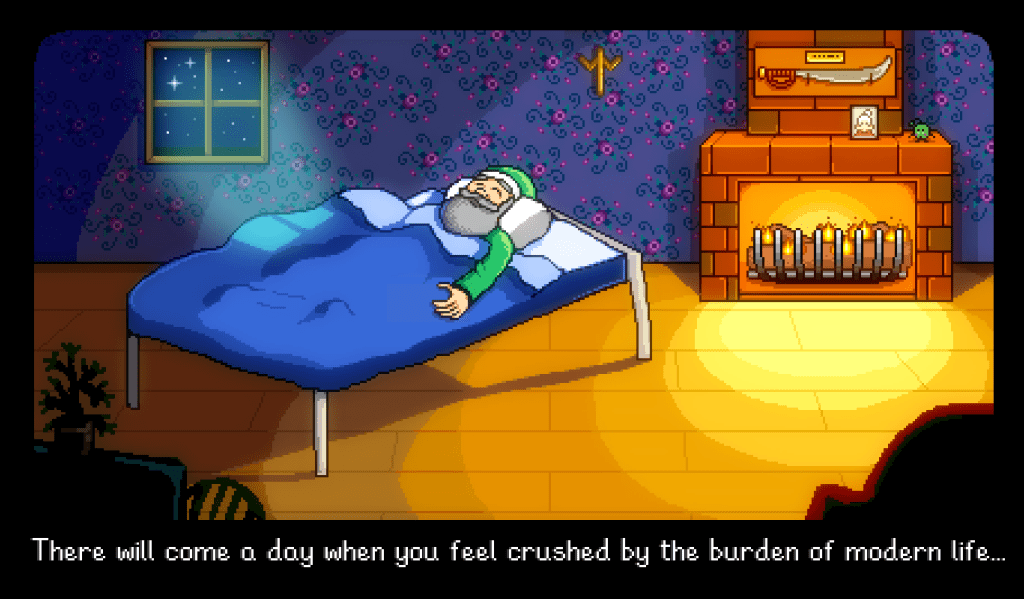
The player wants to start their farm with zero financial support to see if they can make it on their own. They want to use their experiences working for JojaMart’s corporate office for good. They askew the traditional path of using the 500 gold as seed money (literally), as this is starting too small. When the player starts farming, they want it to be at the largest scale possible.
Their motivations for starting off large are beating JojaMart at their own game and following in their grandfather’s footsteps. The player sees the best way to do this is by supporting Pierre’s General Store with large orders that dwarf anything JojaMart could achieve. This will position Pierre to undercut JojaMart’s prices, pushing them out of the market, thereby beating them at their own game.
While the player has nothing but contempt for their former employer, this is more than taking over a farm. The player wants to make amends for working at a company that’s focused on destroying the community their grandfather loved.
Economic Considerations
Do you think Pierres General Store’s inventory could support a large amount of purchases from a player who saved up for 1 year? His store isn’t that big, so it wouldn’t be realistic if the player bought the max amount of goods possible at the start of year 2. Pierre likely doesn’t have that sort of inventory on hand.
Additionally, we don’t know who is buying things from the shipping box all of the time. We assume Pierre is the bulk of the orders. Whoever they are, they likely lack the funds to buy goods from someone who spent the past year hoarding. We see two options for year 2 to continue the challenge:
- Ignore economic realism and spend as much as you would like. Do this if you want to hit the ground running the second year. We recommend this if you want to explore something about the game you haven’t experience yet.
- Try to maintain economic realism by working within the limitations of what an average player spends their first year for year two. We recommend this if you want to try and keep within the spirit of the challenge.
The next section goes over what we estimate the average player spends their first year using two different models. If the math doesn’t interest you, click here to go to the recommended numbers to follow.
Spending Analysis
Year 1 Average Spending Models
We ran two models using Perplexity Pro to estimate income and expenses for year 1.
- Model 1: Detailed guidelines about how we play the game on average.
- Model 2: General idea of what an average player can accomplish.
Model 1 Guidelines
- In bed every day by midnight.
- Morning to noon is time spent on the farm and foraging for things to sell.
- Noon – 11pm is for either fishing or the mines.
- They want to complete the community center in the first year.
- 2 upgrades for all tools the first year.
- Player selected meadowland farms to start with chickens, they want to get cows the first year.
- They aren’t going to romance someone until year 2, so that is when they’ll focus on marriage.
- The crops they grow are a mix of all seeds available. They also keep at least 5 of each crop they grow in a chest for future gift giving.
The following sections are model 1’s suggested spending and expenses by season.
Model 1: Spring
| Days | AM Activities | PM Activities | Weekly Expenses | Weekly Income | Week End Balance |
|---|---|---|---|---|---|
| 1-7 | Clear farm space, plant parsnips, forage | Fishing at mountain lake, get fishing rod | Basic backpack (2000g), 20 parsnip seeds (400g) | +3000g from fishing, 500g from forage | +1100g |
| 8-14 | Water crops, clear more farm space | Mining to level 20, gather copper | 50 potato seeds (2500g), Chicken coop (4000g) | +5000g from fishing/mining | -1500g |
| 15-21 | Farm maintenance, buy strawberries at festival | Mining to level 40 | 20 strawberry seeds (2000g), 2 chickens (1600g) | +6000g from crops/eggs | +2400g |
| 22-28 | Harvest strawberries, plant new crops | Fishing and mining alternately | Copper tool upgrades (4000g) | +8000g from mixed income | +4000g |
Spring Totals
Income: +22,500g
Expenses: -14,500g
Model 1: Summer
| Days | AM Activities | PM Activities | Weekly Expenses | Weekly Income | Week End Balance |
|---|---|---|---|---|---|
| 1-7 | Plant blueberries, melons | Mining to level 60 | Summer seeds (4000g) | +7000g from crops/mining | +3000g |
| 8-14 | Farm maintenance, build silo | Fishing for bundle items | Steel tool upgrades (10000g) | +12000g from blueberries | +2000g |
| 15-21 | Harvest crops, replant | Mining for gold ore | Barn construction (6000g) | +15000g mixed income | +9000g |
| 22-28 | Farm expansion | Deep mine runs | Cow purchase (4000g) | +12000g mixed income | +8000g |
Summer Totals
Income: +46,000g
Expenses: -24,000g
Model 1: Fall
| Days | AM Activities | PM Activities | Expenses | Income | Week End Balance |
|---|---|---|---|---|---|
| 1-7 | Plant cranberries, pumpkins | Mining for bundle items | Fall seeds (5000g) | +15000g mixed income | +10000g |
| 8-14 | Farm maintenance | Skull Cavern prep | Quality sprinklers materials (8000g) | +18000g from crops | +10000g |
| 15-21 | Bundle organization | Deep mining runs | Final tool upgrades (15000g) | +20000g mixed income | +5000g |
| 22-28 | Final crop harvest | Community center completion | Bundle purchases (10000g) | +25000g mixed income | +15000g |
Fall Totals
Income: +78,000g
Expenses: -38,000g
Model 1: Winter
| Days | AM Activities | PM Activities | Expenses | Income | Week End Balance |
|---|---|---|---|---|---|
| 1-7 | Winter forage, greenhouse prep | Deep mining | Winter seeds (2000g) | +10000g mining/animals | +8000g |
| 8-14 | Animal care, crystalariums | Skull Cavern runs | Barn upgrade (8000g) | +12000g mixed income | +4000g |
| 15-21 | Greenhouse management | Mining for iridium | Processing machines (5000g) | +15000g mixed income | +10000g |
| 22-28 | Winter crops harvest | Final preparations | Storage expansions (3000g) | +10000g mixed income | +7000g |
Winter Totals
Income: +47,000g
Expenses: -18,000g
Model 1: Year 1 Totals
Total Income: +193,500g
Total Expenses: -94,500g
Final Thoughts on Model 1 & Guidelines for Model 2
The numbers seemed high so we ran another model that asked what the average played could accomplish the first year in a meadowlands farm, assuming they complete the community center, raise cows, and mined and fished equally throughout the year.
Model 2: Spring
- Initial chicken eggs: 150g per day from 2 chickens
- Early crops: parsnips provide about 750g profit per 1,000g investment over 4 days
- Cauliflower: approximately 1,100g profit per 1,000g investment over 12 days
Total Income: 11,000g
- Crops (mainly parsnips, cauliflower): 7,500g
- Animal Products (eggs, mayo): 2,000g
- Mining/Fishing: 1,500g
Total Expenses: 8,000g
- Seeds: 1,000g
- Tools: 2,000g
- Community Center: 5,000g
Model 2: Summer
Total Income: 12,800g
- Crops (blueberries, hops): 9,300g
- Animal Products: 2,000g
- Mining/Fishing: 1,500g
Total Expenses: 9,000g
- Seeds (blueberry seeds at 80g each): 2,000g
- Tools: 2,000g
- Community Center: 5,000g
Model 2: Fall
Total Income: 24,500g
- Crops (pumpkins, cranberries): 21,000g
- Animal Products: 2,000g
- Mining/Fishing: 1,500g
Total Expenses: 10,000g
- Seeds: 3,000g
- Tools: 2,000g
- Community Center: 5,000g
Model 2: Winter
Total Income: 7,000g
- Animal Products: 5,000g
- Mining/Fishing: 2,000g
- No crop income due to season
Total Expenses: 7,000g
- Tools: 2,000g
- Community Center: 5,000g
- No seed expenses
Model 2: Major Expenses
- Backpack upgrade: 2,000g (first), 10,000g (second)
- Tool upgrades: Bronze tools during winter
- Well construction: 1,000g plus 75 stone
- Community Center bundles: Various costs throughout year
Model 2: Annual Projections
- Total crop revenue: 40,000-60,000g
- Animal product revenue: 20,000-30,000g
- Mining/Fishing revenue: 15,000-25,000g
- Total expenses: 30,000-45,000g
- Net profit by year end: 45,000-70,000g
Review of both Models
Model 1: Seems aggressive but tracks because we told it we weren’t going to romance anyone until year 2. So it probably ran the model as not talking to anyone in town or participating in an events.
Model 2: Feels like it’s a true average across YouTube videos and reddit comments. The numbers are from people who have played the game before and people who are playing for the first time that have questions.
Model 1 vs Model 2 Expenses
| Season | Model 1 | Model 2 | Delta |
| Spring | 14,500 | 8,000 | 6,500 |
| Summer | 24,000 | 9,000 | 15,000 |
| Fall | 38,000 | 10,000 | 28,000 |
| Winter | 18,000 | 7,000 | 11,000 |
What Numbers to Follow?
Finding a middle ground between both models appears to be a safe assumption. Halving the difference between both models and then adding it to model 2 is how we got our recommended numbers to follow. It puts the numbers between both models and doesn’t feel outside the range of our past games. It also follows a logical progression most players face their first year: building up numbers into the fall and then a decline back towards spring’s numbers as crops are limited. See chart below for what this looks like.
Here is a link to the graph above that shows the animation and you can click on each season to see the exact numbers: https://public.flourish.studio/visualisation/21660494/
Year 2 Suggested Spending Summary
The table below is suggested spending for each season. Use the last column if you want to have a spend plan by season and not worry about how much to spend by week.
| Season | Model 1 | Model 2 | Delta | (Delta/2) + Model 2 |
| Spring | 14,500 | 8,000 | 6,500 | 11,250 |
| Summer | 24,000 | 9,000 | 15,000 | 16,500 |
| Fall | 38,000 | 10,000 | 28,000 | 24,000 |
| Winter | 18,000 | 7,000 | 11,000 | 12,500 |
Year 2 Spending Plan by Week
If you want to restrict yourself even further in the spirit of the challenge, divide the above numbers by 4 to show what a player can spend by week for each season. Spending the total amounts listed below on the 1st, 7th, 14th, and 21st for each season should be in line with an average player’s economy of a normal play through. We chose to round the numbers for simplicity’s sake.
| Total Season Spending | Suggested Weekly Rounding | |
| Spring | 11,250 | 11,250/4 = 3,000 |
| Summer | 16,500 | 16,500/4 = 4,000 |
| Fall | 24,000 | 24,000/4 = 6,000 |
| Winter | 12,500 | 12,500/4 = 3,000 |
Suggested Year 2 Spend Plan
Below is an example of how we stuck to the spending plan by season.
| Spring | Credited | Purchased | Amount Spent | Week End Balance |
| 1st | +3,000 | Backpack for player 1 | -2,000 | 1,000 |
| 7th | +3,000 + 1,000 (week prior) = 4,000 | Backpack for player 2 2x tickets to Calico Desert | Backpack: -2,000 Tickets: -1,000 | 1,000 |
| 14th | +3,000 + 1,000 (week prior) = 4,000 | 2x tickets to Calico Desert | Tickets: -1,000 | 3,000 |
| 21st | +3,000 + 3,000 (week prior) = 6,000 | 1x Silo 2x tickets to Calico Desert | Silo: -100 Tickets: -1,000 | 4,900 |
| Summer | Credited | Purchased | Amount Spent | Week End Balance |
| 1st | +4,000 + 4,900 (week prior) = 8,900 | Various seeds | Seeds: -900 | 8,000 |
| 7th | +4,000 + 8,000 (week prior) = 12,000 | Coop 2 upgrade, axe upgrade | -12,000 | 0 |
| 14th | +4,000 | 2x bus tickets, seeds, pickaxe upgrade | -3,800 | 200 |
| 21st | +4,000 + 200 (week prior) = 4,200 | 2x bus tickets | 1,000 | 3,200 |
| Fall | Credited | Purchased | Amount Spent | Week End Balance |
| 1st | +6,00 + 3,200 = 9,200 | 0 | 9,200 | |
| 7th | +6,000 + 9,200 = 15,200 | 0 | 15,200 | |
| 14th | +6,000 + 15,200 = 21,200 | Coop 3 upgrade, 2x bus tickets | -21,000 | 200 |
| 21st | +6,000 + 200 | 0 | 6,200 |
| Winter | Credited | Purchased | Amount Spent | Week End Balance |
| 1st | +3,000 + 6,200 | 9,200 | ||
| 7th | +3,000 + 9,200 = 12,200 | Upgraded cabin | -10,000 | 2,200 |
| 14th | +3,000 + 2,200 = 5,200 | 2nd Axe upgrade | 2 | 200 |
| 21st | +3,000 + 200 | 3,200 |
Beyond the Challenge
Year 3
Do what you want! Feel the thrill of nothing holding you back until your balance hits rock bottom. We got close to zero about half way through spring, but bounced back pretty quickly. After playing around for a season we decided the next challenge should be the all too common perfection run you see on every single website about SDV challenges.


 Adventures in the Valley